DIRAC-3
Dirac-3S is a specialized quantum optimization machine based on Entropy Quantum Computing (EQC) technology. It is designed to address complex, highly interconnected optimization problems by mapping mathematical objective functions into the evolution of a physical photonic system.
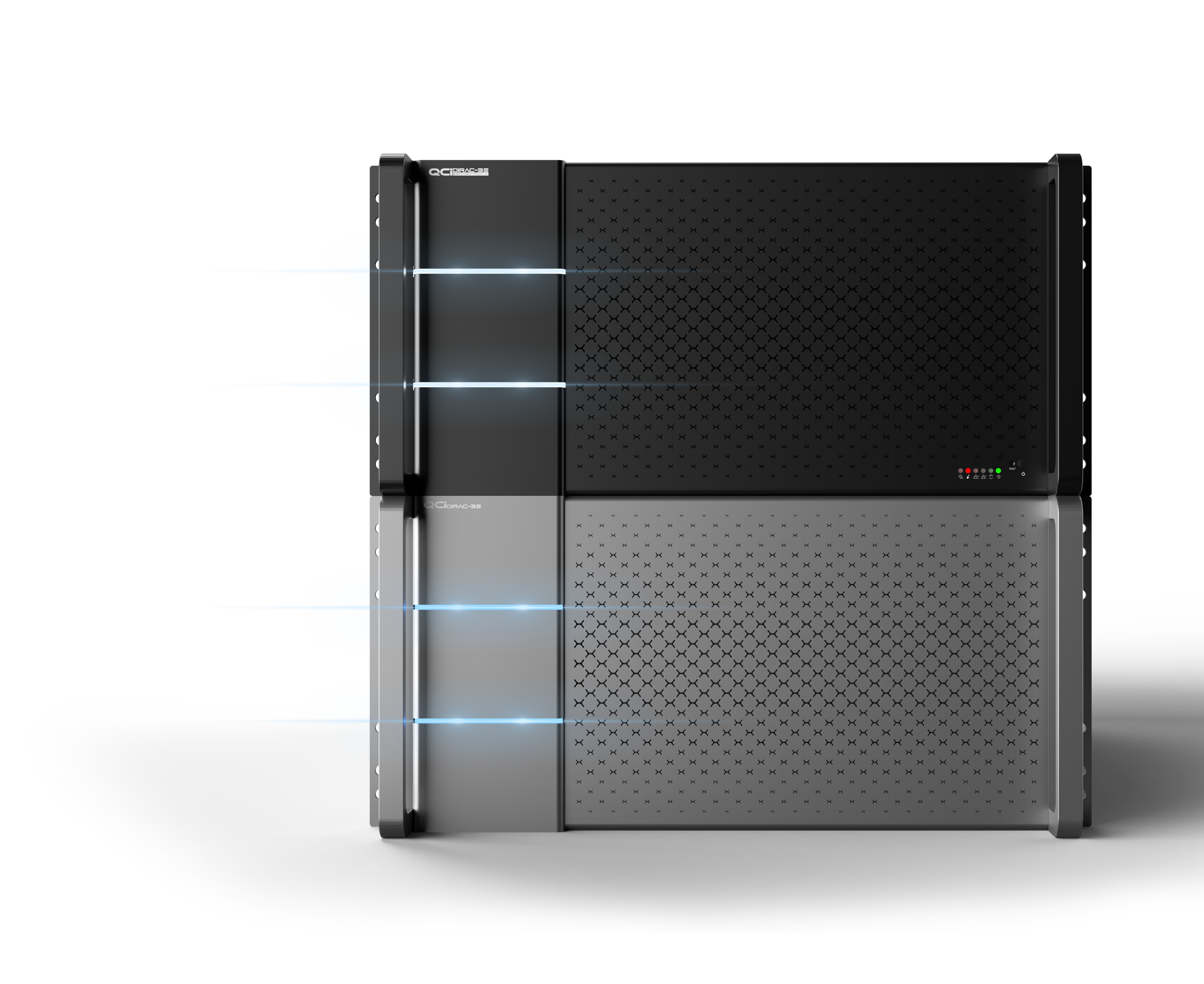
With the new Dirac-3S, even larger optimization problems are within reach. With up to 5th order problems, and up to 9,980 variables, this is our most powerful entropy quantum computer yet.

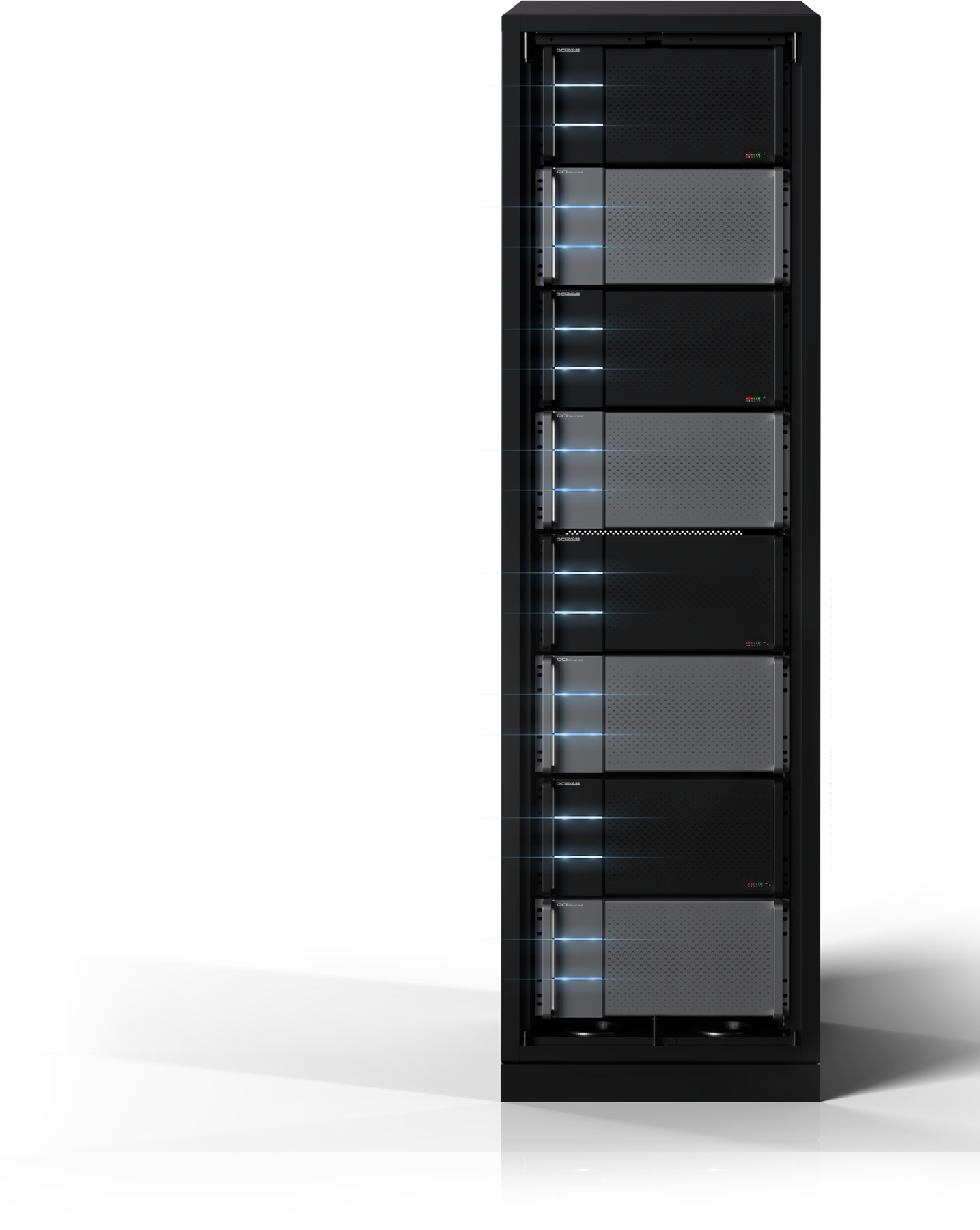
Room temperature and server rack ready
Raising the bar
In our benchmarking study, Dirac-3S achieved the strongest overall performance across the DIMACS benchmark suite.

Our next generation of Dirac-3
Speed
Dirac-3S is engineered to efficiently solve increasingly complex optimization problems, with practical computation times demonstrated on problems involving up to 9,980 variables while consistently finding the optimal solution. This enables customers to tackle larger problems and explore more possibilities in less time.
Scale
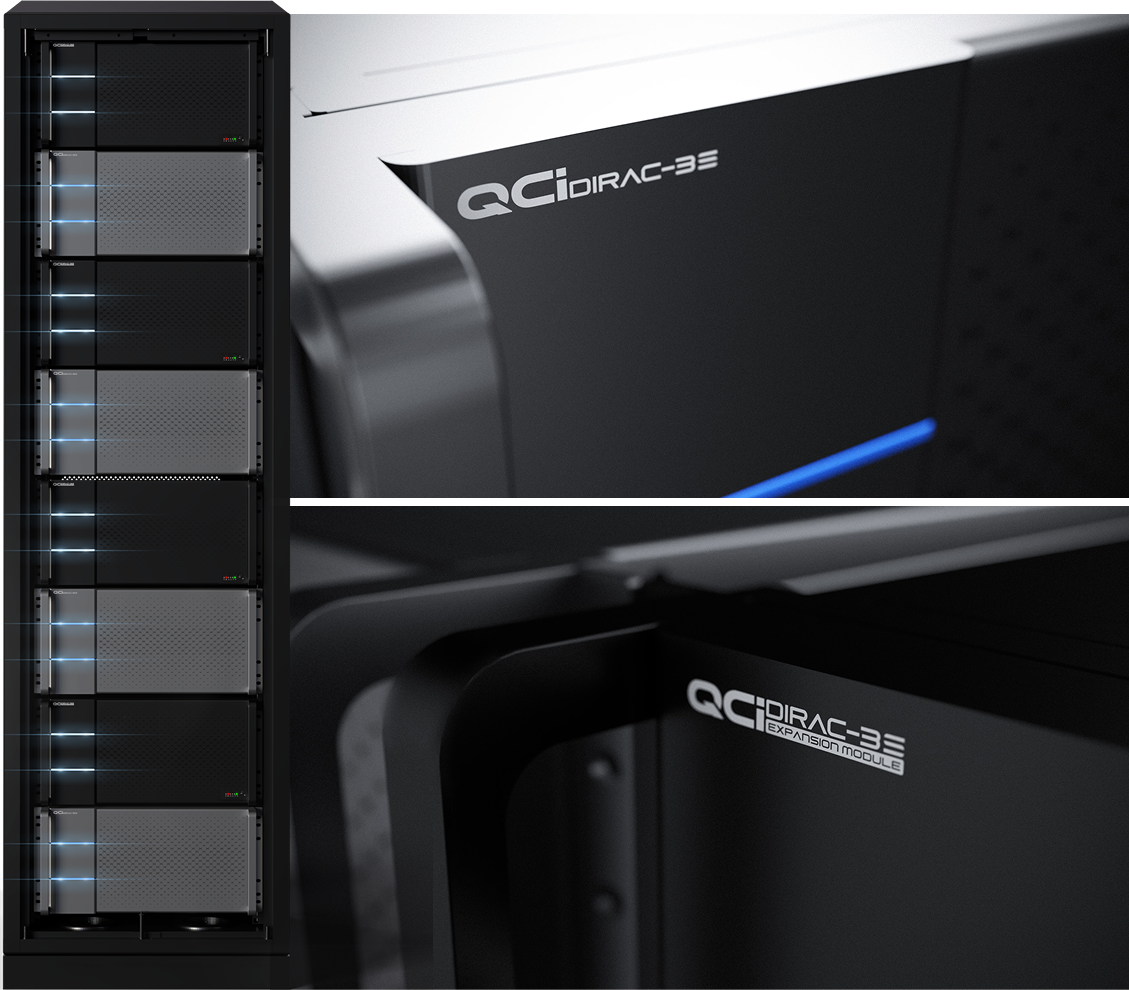
Dirac-3S features a modular architecture designed to scale with customer requirements. The compact 5U base system can be extended with Expansion Modules to support larger and more complex optimization problems, with QCi demonstrating configurations supporting up to 9,980 variables with one Expansion Module. The architecture is designed to accommodate additional Expansion Modules, enabling customers to expand their system as their optimization needs grow. QCi has also advanced the Dirac-3S hardware architecture, manufacturing processes and supply chain to support increased production volumes, consistent product quality and broader commercial deployment. These improvements include enhanced error correction, component control and operational reliability.
Solutions
Dirac-3S is designed to address a broad range of real-world optimization problems on a single platform, through multiple optimization approaches including continuous, integer and higher-order optimization. QCi’s latest error-correction techniques are designed to improve solution quality across applications in financial services, logistics and supply chains, manufacturing, energy, telecommunications, scientific research, and aerospace and defense.
The platform can be deployed on-premises or in the cloud and integrated into AI/ML pipelines, enabling organizations to incorporate quantum optimization into existing computational workflows.
Solving bigger problems
Supply chain & logistics
Financial planning
Physics simulations
Fraud detection
Medicine
Your use case here
Being different makes all the difference
We are making steps with an unconventional approach to computing with nanophotonics and quantum optics. And we have the papers to prove it.
Entropy Computing: A Paradigm for Optimization in an Open Quantum System
Motzkin-Straus Optimization on an Entropy-Computing Platform
Standard Quadratic Formulations of Many NP Problems:A Simplex-Based Compilation...
The computationally hard made easy
Dirac-3 is purpose-built to solve computationally hard optimization problems and provide a polynomial advantage for approximate solutions. To learn how to use Dirac-3, visit our Introduction to Dirac-3 learning module.
Discrete solver
Non-convex Optimization
Two body interactions
Combinatorial optimization
All to all connectivity
Low power consumption
Quantum machines for a brighter future

Let's get a little technical
A brief description
Dive a little deeper into how Dirac systems work. For a detailed explanation, see the Dirac-3S user guide
In quantum information processing, loss and noise are usually detrimental and must be minimized. This is why quantum systems using atomic and alike qubits must be hosted in cryogenic vacuum chambers, and why photon loss is the roadblock to quantum communications and computing. This requirement translates to exceeding challenges in quantum system manufacture and operations, and has been the bottleneck preventing the scaling up of the qubit number and connectivity.
With entropy quantum computing, we flip the coin around. Instead of trying to avoid loss and noise, we harness them to build quantum machines whose capacity and speed outmatch existing computing modalities.
This fundamentally new quantum computing approach is called Entropy Quantum Computing (EQC). It roots deeply in the intriguing principles of quantum mechanics. First, loss or decoherence of a quantum state occurs through its coupling to an entropy source with many degrees of freedom. The apparent diminishing of quantum characteristics as a result is just a statistically averaged manifestation of many possible outcomes of such coupling. Second, vacuum is never quiet, although it does not appear to contain any energy or particle. There are, in fact, enormous amounts of random fluctuations occurring at all times in each of the vacuum mode.
EQC is conceived and developed with those intriguing quantum principles. Rather than trying to create and manipulate pristine qubits isolated from the environment, EQC utilizes loss and decoherence, and turns entropy into super-power fuels of its computing engine. In sharp contrast to any existing quantum platforms, there is no need for cryogenic or isolated housing, and the implementation can use integrated photonics, leading to SWAP-C friendly devices, just like regular PC’s.
How it works
Our quantum analog computers take an ising hamiltonian as an input and find the lowest energy state, solving highly interconnected variable optimization problems, very quickly.
These problems correspond to minimizing or maximizing the expected return of the objective function:

under the constraint of a fixed resource where is the value of each variable, is the linear coefficient of each variable, which is a real number that can be positive, negative, or zero, is the coupling coefficient of two variables, which can be any real number.

Frequently asked questions
All that is required is a computer that can access the network location of the Dirac-3 device over a network or wired connection.
Since our Dirac systems run at room temperature (being mindful of areas with with larger fluctuations such as near heating or AC vents) and use industry standard I/O, they can be integrated into your data center without having to make any changes to your existing IT infrastructure footprint or facility. More details on the integration can be found in our user guide here.
We offer a comprehensive, flexible suite of quantum professional services including problem identification, formulation, execution, monitoring, results analysis, and training. These services are provided by highly experienced quantum scientists, with extensive backgrounds in mathematics, quantum physics, AI/ML, or optimization.
You can purchase time allocation in blocks. As a user submits problems to the queue, the run time of a problem is deducted from the user’s available time allocation balance. The run time deducted for a particular problem represents only the time when the problem is running on a Dirac machine – you are not “charged” for time spent in the queue. Blocks of time allocation can be used for up to 12 months and can be used on any of Dirac-1, Dirac-2, or Dirac-3 that are available on QCi’s cloud. Once your available time allocation is consumed, the user will be unable to submit problems to the queue until the allocation balance is increased.
If you run a problem that consumes more Time Allocation than you have in your balance, the submitted problem will still be queued and processed. Your Time Allocation will then reflect a negative balance for any overage consumed. You must purchase sufficient additional Time Allocation to obtain a positive balance before new problems can be submitted to the queue. For example, if you have a negative balance of 4 minutes and purchase a 60 minutes of Time Allocation, your net balance will then reflect 56 minutes of Time Allocation and then you will be permitted to submit problems.
The time it takes to run a problem can vary greatly, depending on the problem you run. In general, the time required scales linearly to the size of the problem, but the selected schedule can have an effect as well. Small test problems may only take a few seconds. Larger problems could take several minutes. This does not include the time in queue, which you will not be charged for. More info can be found here.
QCi offers Dedicated Access to our Dirac-1, Dirac-2 and Dirac-3 machines, so that users may access these machines without any interruption from other problems in the queue. Dedicated Access is provided on an hourly reservation basis.
Additionally, during those Dedicated Access sessions, a QCi Application Scientist is available to provide the user with over-the-shoulder technical support and application coaching.